SaaS Platform Development: Multi-Tenant Architecture and Subscription Billing
SaaS platform development: multi-tenant data isolation, subscription billing via iyzico, PayTR or Stripe, roles and an admin panel. The code stays yours.
Our MVP development page is for validating an idea with a first version, while this page is for building a software product that you will sell to many customers on a subscription. The platform described here is one you commission from us and sell under your own brand. We are not talking about Detartech's own products. The code repository, the database and the server or cloud accounts are preferably opened in your name from the start. The full source code and all access are handed over to you, and the code stays yours. The rest of this page walks through the decisions such a platform needs, in order: separating customer data, subscriptions and payments, roles and the admin panel, scaling and running costs, release management, the items that shape the quote, and how we work.
What is a SaaS platform, and when is a ready-made one not enough?
SaaS (Software as a Service) is software that people use in a browser or an app without installing anything, and pay for with a subscription. One codebase and one running system serve many customer organizations at the same time. Each customer sees its own data, its own users and its own settings, but the same application runs underneath. This differs from custom software built for a single company in three ways. As the number of customers grows, their data must never mix. Billing is a recurring charge, not a one-time payment. And a new release reaches every customer at once.
Not every SaaS idea needs software built from scratch, and we say so in the first meeting. If an existing product already covers the service you want to sell, starting with that product or with a ready-made solution offered under your brand can be faster and cheaper. A custom platform makes sense in these cases:
- The value you sell to your customers is the software itself, and your workflow does not fit the assumptions of ready-made products.
- Your pricing model (per user, by usage or by module) does not fit the plans that ready-made tools offer.
- Your customers want integration with their own systems, their own domain or use under their own brand.
- The product code and customer data must stay with you as a company asset, and you need to show this during investment or acquisition.
If you are undecided, we go through the service you want to sell and your target customers together in the first meeting. If the answer points to a ready-made solution, that is what we recommend.
Multi-tenant architecture: data isolation and per-customer configuration
In a multi-tenant architecture, each customer organization is defined as a tenant, and every record in the system carries a tenant identifier. Our standard approach applies this separation at two layers. At the API layer, every request is resolved against the tenant of the signed-in user, and a request for another tenant's record is rejected. At the database layer, queries are also restricted by the tenant identifier. That way, a single filter forgotten in application code does not expose another customer's data. With both layers working together, one mistake is less likely to turn into a data leak. Tests that try to reach one tenant's data with another tenant's user check that the separation actually works.
Per-customer configuration is part of the same architecture. Each tenant can have its own logo, colors, language and time zone, enabled or disabled modules and plan limits. We do not hard-code these settings. We store them in the database as tenant settings. Adding a new customer then becomes an action in the admin panel, not a software task. When one customer asks for something special, the question is this: is it a setting that could be offered to all customers, or a code branch for one customer only? The second path looks easy in the short term, but it adds maintenance work to every release. So we keep customer-specific code as the exception and build every request that can become a setting as a setting.
Some situations call for stricter separation, for example a large customer who wants its data kept in a separate database. Options like this change both running costs and release management. If you need one, we discuss it during discovery and list it separately in the quote.
Subscription, billing and payment infrastructure
In a SaaS product, payment is not a single checkout screen. It covers the customer's whole relationship with the product. The subscription layer settles these questions: plans and prices, monthly or yearly periods, trial periods, proration on upgrades and downgrades, user or usage limits, and cancellation and refund rules. These rules live in their own layer of the platform. When a price changes or a new plan is added, that layer also defines how existing subscribers are affected.
The payment providers we work with in production are iyzico, PayTR and Stripe. Which one fits depends on where your customers are, the currency and the method the provider offers for recurring charges. Card numbers never enter your platform's database. The card is captured through the provider's own secure payment form, and recurring charges use the method the provider supports. Events such as a failed charge, an expired card or a refund are processed through notifications from the provider (webhooks), and the subscription status is updated accordingly. How long a customer gets after a failed charge, and how access is restricted, are business rules written down from the start.
On invoicing, we draw a clear line. The platform keeps subscription and payment records and reports on them. Your legal invoicing process depends on your accounting setup. We do not promise an e-invoicing provider integration on this page. If you need one, we assess it separately during discovery.
User, role and permission management; the admin panel
A multi-tenant platform has two separate levels of permission. The first is inside the customer organization: a tenant's administrator invites their own team, assigns roles and decides who can see what. The second is your own team as the platform owner: it sees all tenants, manages subscriptions and provides support. These two levels must not mix. We define roles and permissions in a single permission model, not screen by screen. So when a new screen is added, nobody has to debate separately which role can access it.
For sign-in, options such as email and password, one-time code verification, or single sign-on (SSO) with the identity systems of enterprise customers are chosen to fit the need. If your support team has to enter a customer's account to investigate a problem, that access requires permission and is logged. Important actions such as role changes, plan changes and data deletion are also kept in an activity log.
The admin panel is the tool you run the platform with. For your team, it holds the tenant list, subscription and payment status, plan and price settings, usage data and support screens. Your customers get a separate admin area where they manage their own users, payment history and settings. These screens often take as much effort as the customer-facing side of the product, so they appear as a separate item in the quote.
Scaling, monitoring and running costs
As a SaaS product gains customers, two things grow together: load and running costs. Building the architecture for the largest possible scale on day one is a needless expense. Building it without any thought means an expensive rewrite later. So we write down which parts stay simple in the first version and what will change when growth comes. For example, long-running jobs such as report generation, bulk imports and sending emails go to background queues so users are not kept waiting, and frequently read data is cached.
In a multi-tenant system, heavy use by one tenant must not slow down the others. Per-tenant rate limits and usage metering keep this balance. The same measurements are also the basis of usage-based pricing. On the monitoring side, we track error logs, response times, queue status and whether payment notifications are being processed. When something goes wrong, the team is alerted. The aim is to see the problem before your customers do.
Running costs, meaning servers, databases, storage, email and third-party services, are billed to your own accounts and are not hidden inside the development fee. Talking early about how each item grows with the number of customers also matters for your pricing decision. When growing load turns into a bottleneck, the work moves to backend scaling. Measurement, database and query optimization, and cache and queue layers are covered in detail there.
Release management and deployment (CI/CD)
In software installed for a single company, a new release affects one customer. In a SaaS product, it affects every customer at once. That is why the deployment process has to be automated, repeatable and reversible. Every time the code changes, automated tests run, the release is first tried in a test environment that mirrors production, and then it goes live. If a problem appears, rolling back to the previous version is planned in advance.
Database changes need extra care in a SaaS product, because they affect the data of all tenants at the same time. We make schema changes in steps that let the old and the new version run side by side for a while. Feature flags can be used to turn a new feature on for selected tenants first, so it is tested with a limited group before everyone gets it. For pipeline setup, environment and secret management, and monitoring details, see our DevOps and CI/CD service.
When and how you inform your customers is also part of release management: planned maintenance notices, release notes and a transition period for features whose behavior changes. We write these rules together with the product.
What determines the cost
We do not list a price or a timeline on this page, because no two SaaS products have the same scope. The quote comes after a discovery call and is made up of these items:
- Product functions: what users do with the product, the number of screens and the complexity of the business rules.
- Tenant model: whether standard data isolation is enough, and the scope of per-customer configuration.
- Subscription and payment: the plan structure, whether there is usage-based pricing, the payment provider and the currencies.
- Roles and admin panels: the depth of the permission model and the admin screens for your team and your customers.
- Integrations: connections to your customers' systems and to third-party services.
- Infrastructure and operations: expected usage, monitoring, backups and the scope of the deployment pipeline.
- Languages and markets: which languages the product will support and which countries it will be sold in.
These items are clarified with you in the discovery call and turned into a written quote. The quote shows the edges of the scope as clearly as its contents: which functions stay out of the first version, and how a request that arrives later will be priced. Until the scope is clear, we do not name a timeline or a figure. Cloud, payment provider and other third-party fees appear on separate lines and are paid directly from your own account.
Process and handover: discovery, design, development, launch
The work moves through the stages below, and each one builds on the approved output of the one before:
- Discovery: the service you will sell, your target customers, your pricing idea, the tenant model and the priorities become clear. At the end of this stage you receive the written quote.
- Design: the data model, the tenant and permission structure, the subscription flows and the screen flows come to you for approval.
- Development: work moves in short cycles. At the end of each cycle you use what was built yourself, in the test environment.
- Launch: payment scenarios, separation between tenants and behavior under load are tested before going live, and the release is planned so the previous version can be restored if needed.
The code repository, the database and the server or cloud accounts are preferably opened in your name at the start of the project, so handover does not become a separate migration job. The full source code and all access are handed over to you, and the code, data and accounts stay yours. After launch, a free support period begins, sized to the scope and duration of the project, during which we handle small fixes. After that period, maintenance and change requests are billed separately. Since the code and the accounts are yours, you do not have to stay with us for maintenance, and you can continue with your own team. To request a discovery call, use our contact page.
Key Benefits
- Tenant data isolation at both the API and database layers
- Per-customer settings: branding, modules and plan limits
- Subscriptions and recurring charges via iyzico, PayTR or Stripe
- One permission model, admin panels for you and your customers
- Automated tests and reversible releases
- Code, data and accounts stay yours, with all access handed over
Frequently asked questions
What is the difference between an MVP and a SaaS platform?
Is the platform built as multi-tenant, or is there a separate installation for each customer?
Who holds the platform's source code and our customers' data?
Should I use a ready-made SaaS solution or build a custom platform?
How are subscription payments and invoicing integration set up?
How does maintenance work after the first version goes live?
 Türkiye
 Witten, Germany
 Solihull, United Kingdom
 United States
Other services in this group
All servicesMVP Development
MVP development for startups and new products from Istanbul: a written validation question, progress visible on a test environment, your code, written handover.
Mobile App Development
Mobile app development for iOS and Android with Flutter and React Native, from Istanbul: version compatibility, offline use, store release, accounts you own.
Web Development
The cost of a web project shows up over time, not at launch. We settle rendering, type safety, multilingual architecture and content management up front.
CTO as a Service
CTO as a Service (fractional CTO): tech leadership without a full-time hire. Architecture decision records, tech debt inventory, vendor and team evaluation.
How We Deliver This Service
Technologies We Use
View AllNext.js
React-based full-stack framework. Build production-grade web apps with SSR, SSG, App Router and Edge Runtime.
React
Component-based UI library by Meta. Breaks complex interfaces into manageable pieces for speed and flexibility.
.NET
Microsoft's modern, cross-platform backend framework. High-performance APIs, microservices and enterprise systems.
Other Projects
View All
Yükpro - Freight & Load Board Platform
We turned Yükpro's AI-assisted prototype, a load board connecting cargo owners with carriers, into a production-ready MVP and launched it on iOS and Android.

Lextum AI - AI-Powered Legal Document Management
SaaS platform for legal professionals offering AI-powered document generation, contract review, real-time collaboration, voice/video calls and versioning.

Leonix - A Supplier Platform Connecting Automotive and Heavy-Duty Parts Manufacturers to the US Market
A platform that connects automotive and heavy-duty parts manufacturers and suppliers from around the world with buyers in the US: supplier panel, admin panel and e-commerce store in one system.
Related Articles
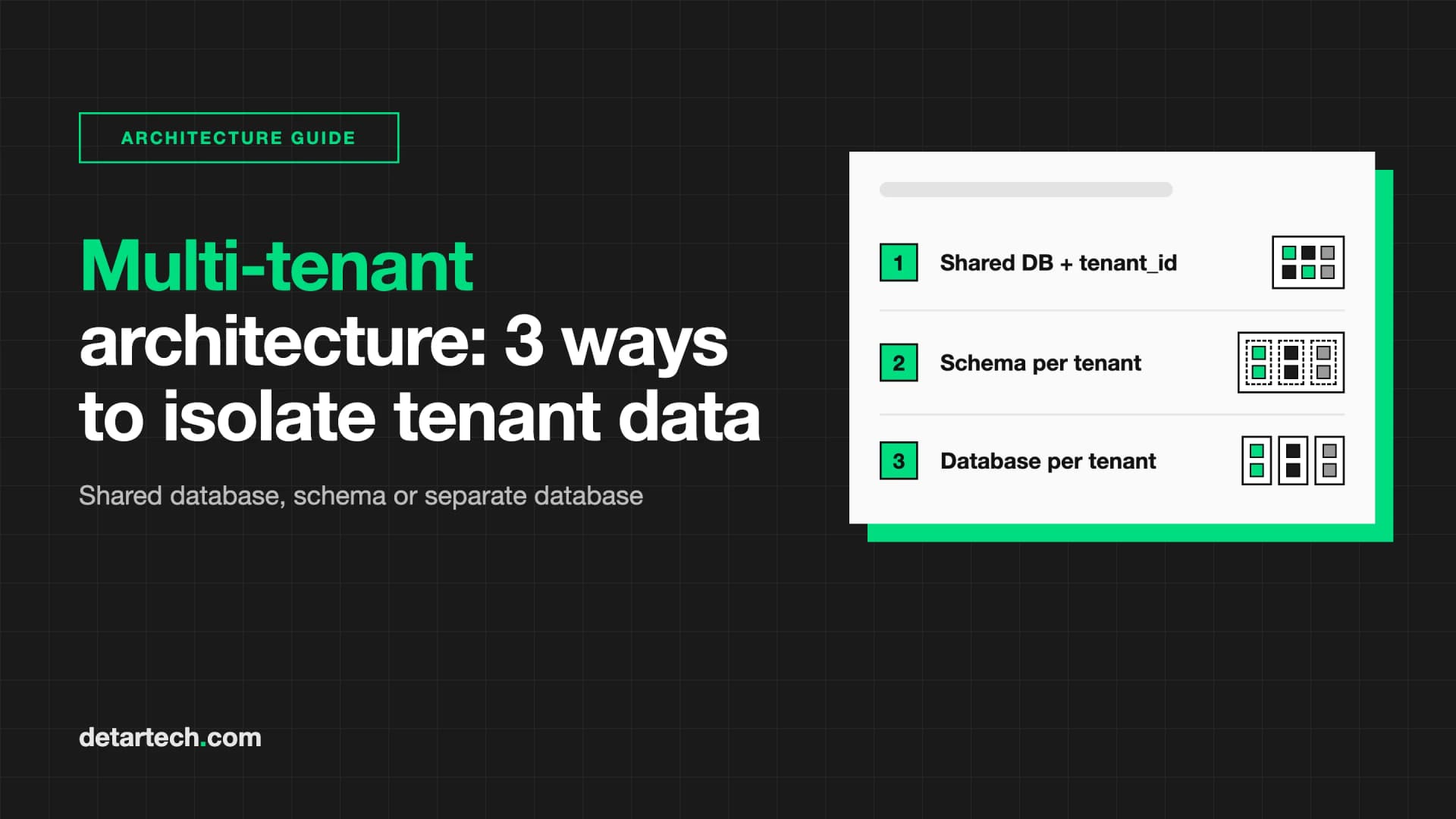
What Is Multi-Tenant Architecture? 3 Ways to Isolate Tenant Data in SaaS
What multi-tenant architecture is, and how a shared database, schema per tenant and database per tenant compare on isolation, cost, RLS, noisy neighbors and migrations.
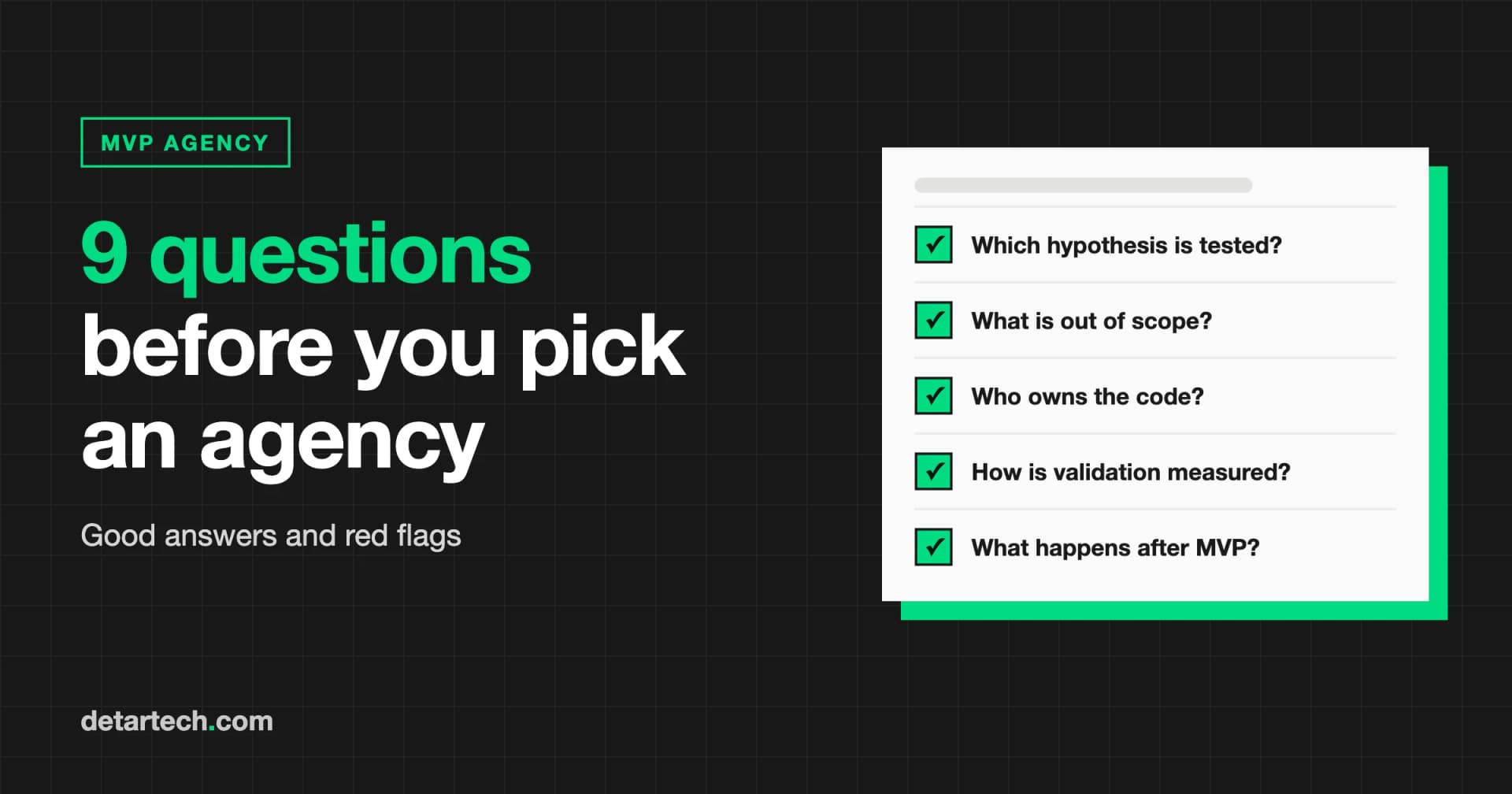
Questions to Ask When Choosing an MVP Agency (and Red Flags)
Nine questions to ask an MVP agency, a good-answer versus red-flag table, and a comparison of agency, freelancer and in-house options.
How to Design Scalable and Maintainable Software Architecture
How to design software architectures that meet not only today's needs but also the future? A practical guide on modular design, clean code, microservices, and CI/CD.
Let's Talk About Your Project
How can we apply this service to your project?
Fill out the quote form for a free 30-minute discovery call.