
Leonix Truck Parts LLC · E-Commerce & Heavy-Duty Truck Parts
Leonix - E-Commerce and Supplier Platform for Heavy-Duty Truck Parts
An e-commerce store, supplier panel and admin panel on one platform for selling heavy-duty truck parts in the US market: OEM-based catalog, approved pricing, multi-warehouse stock and Stripe checkout.

PROBLEM
What Did They Face?
Leonix is a distributor selling heavy-duty truck parts in the US market. The parts come from manufacturers in Türkiye and from suppliers that already hold stock in US warehouses, and the same OEM number can be produced by several brands. Buyers mostly search by OEM number and want to see price and stock status before adding anything to the cart.
Behind the storefront sat a workflow that went beyond a standard e-commerce setup. Suppliers had to be able to upload hundreds of items from Excel, no product could go on sale without Leonix approval, the sale price had to be set with the purchase price, margin, market prices and import cost in view, and online payment could only be taken for stock held in US warehouses. Every step from the moment a product leaves the supplier to the moment it reaches the buyer needed to be traceable from one place.
Access had to be separated too: each supplier should see only its own products, stock and shipments, while the Leonix team manages the whole process from a single screen. That meant the store, the supplier panel and the admin panel could not be separate tools. They had to be designed as one system running on a shared data model.
SOLUTION
What Did We Build?
Detartech built the Leonix platform from scratch: the store, the supplier panel and the admin panel all run on a single API.
A Three-Part Architecture
The core is an API running on ASP.NET Core and PostgreSQL. The supplier and admin panels are one Next.js application: everyone signs in through the same screen and the user's role decides which panel opens. The store is a separate Next.js application that reads and writes data only through the API. Scheduled and background jobs, role-based authorization and an audit trail of changes are part of that core.
OEM-Based Catalog and Multiple Suppliers
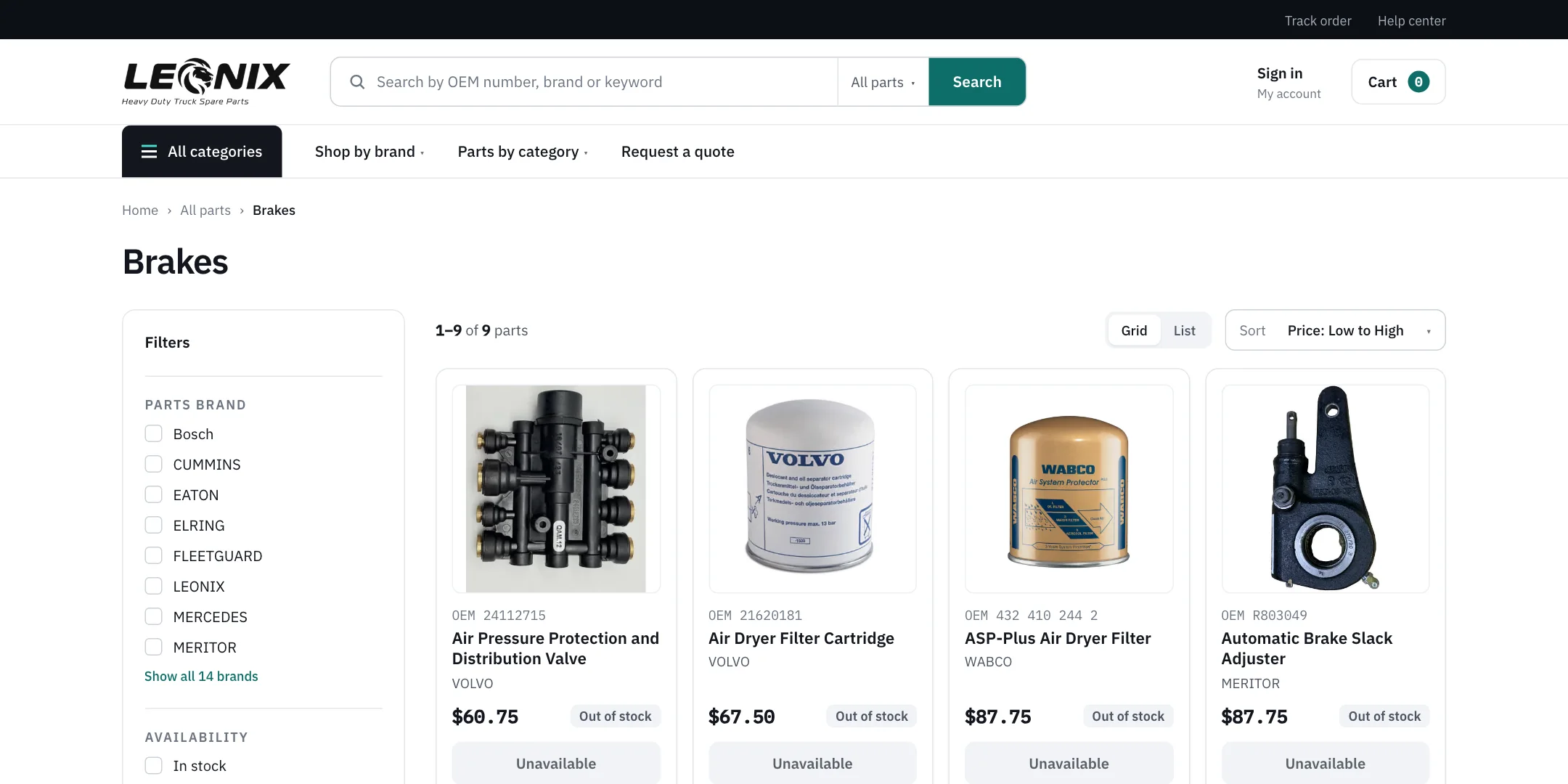
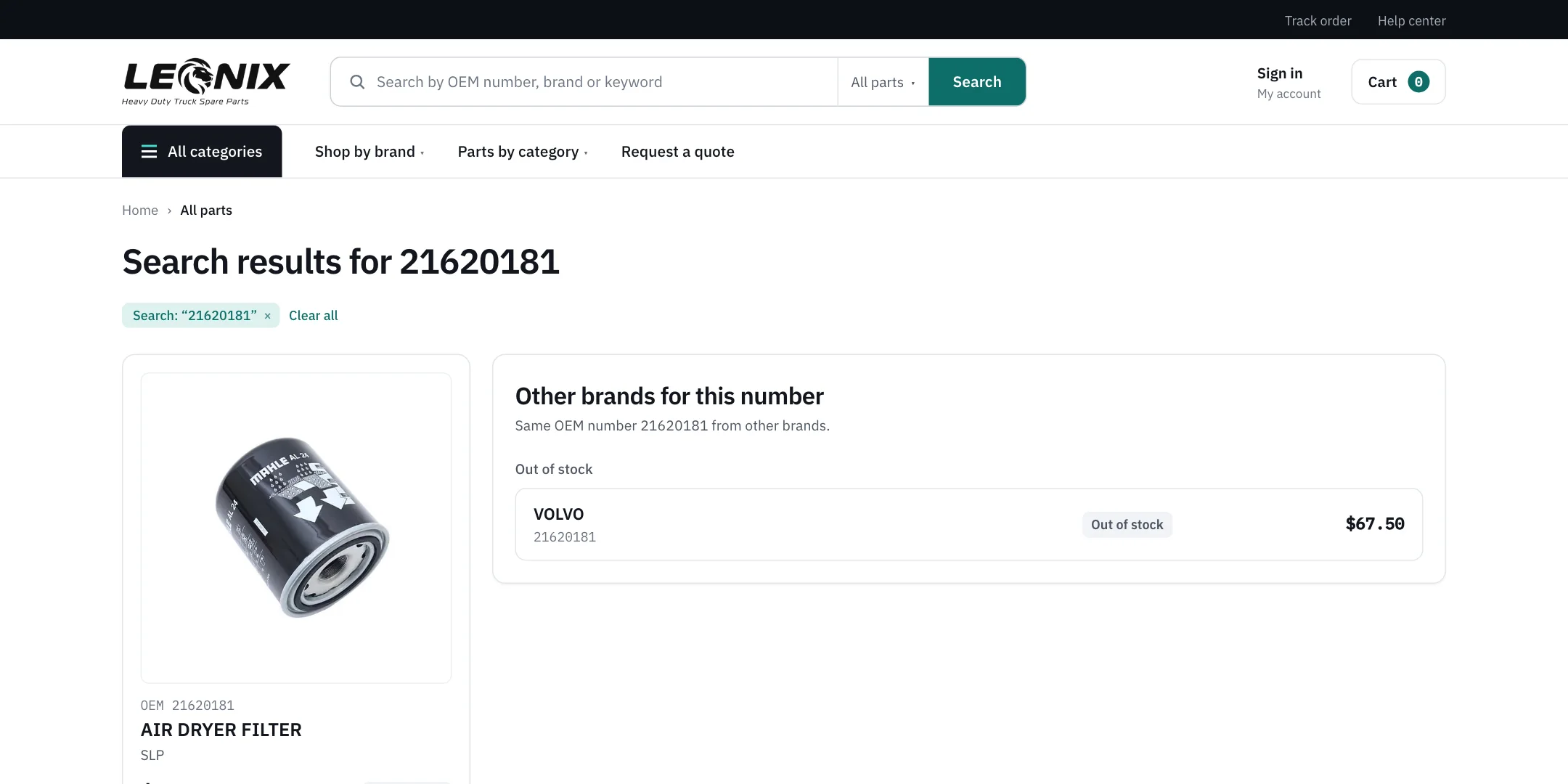
The same part collapses into one product card once OEM numbers are normalized for spaces, hyphens and dots. Each supplier carries its own offer, purchase price and stock, while the buyer sees a single sale price. Stock is pooled across approved offers and drawn down in cost order when an order arrives.
Bulk Excel Upload and Approval Workflow
Suppliers upload hundreds of items at once with a ready-made template. Every row is validated on its own, errors come back as a downloadable report, and the same file cannot be uploaded twice by accident. Uploaded products land in an approval queue where the admin sees the purchase price, the margin-based suggested sale price, market prices and the estimated import cost side by side before deciding.
Warehouses, Shipments and Stock Transparency
Stock in US warehouses is purchasable, while stock at the manufacturer or in transit is separated out with lead times. Shipments, warehouse receipts and transfers between warehouses are tracked in the system, and low-stock alerts point suppliers toward their next shipment.
Our Own Storefront API and Stripe Payments
The store is not tied to an off-the-shelf e-commerce platform. It is Leonix's own sales site, running on a storefront API we built, with payments taken through Stripe. Stock is held briefly while the buyer checks out, the buyer is shown the current price if it changed, an order is created only from a verified Stripe notification, and if payment arrives after stock has run out the amount is refunded automatically. Tests guarantee that concurrent orders cannot oversell stock.
Security and Deployment
Suppliers can only reach their own records; asking for another supplier's record gets the same answer as a record that does not exist. Sign-ins are rate limited with account lockout, passwords follow strong rules and changes are audit-logged. The applications are built and deployed automatically with Jenkins.
RESULTS
What Did They Achieve?
Leonix sells live at leonixusa.com and runs as a single platform together with its supplier and admin panels.
- One platform end to end: the whole process from product upload to approval, pricing, stock, orders and payment is managed from one system.
- Controlled publishing: no product goes on sale without Leonix approval, and prices are set with cost and market information in view.
- Bulk product entry: suppliers can upload hundreds of items in a single Excel file, with errors reported row by row.
- Selling on its own infrastructure: the store runs on its own API and Stripe payments, so orders and stock are managed in one place.
- A transparent buying experience: buyers can find a part by OEM number, and price and stock are visible before anything is added to the cart.
SCREENSHOTS
App Visuals
Behind This Project
Services Used
View AllWeb Development
The cost of a web project shows up over time, not at launch. We settle rendering strategy, type safety, multilingual architecture and content management up front.
DevOps & CI/CD
The point of CI/CD is safe rollback, not speed. Pipeline anatomy, environment and secret management, containers, observability and written handover.
Backend Scaling
Scaling is not adding servers, it is finding the bottleneck. Measurement, database and query optimisation, cache layers, queues and a reversible migration.
Technologies Used
View AllNext.js
React-based full-stack framework. Build production-grade web apps with SSR, SSG, App Router and Edge Runtime.
React
Component-based UI library by Meta. Breaks complex interfaces into manageable pieces for speed and flexibility.
.NET
Microsoft's modern, cross-platform backend framework. High-performance APIs, microservices and enterprise systems.
Let's Talk About Your Project
Want to achieve a similar transformation? Get in touch for a free consultation.