If your organic traffic is falling while your rankings hold steady, you are not alone. The search results page is no longer a list of links; the page itself often answers the question. The user gets the answer and leaves without clicking anywhere.
In this article we look at the size of that shift using data published in 2025 and 2026, then move to the real question: in a world with fewer clicks, how do you earn visibility and how do you measure it?
What the Numbers Say
According to a study SparkToro published in 2026, 68.01% of Google searches in the US ended without a click in the first four months of 2026. In the same team's 2024 measurement the figure was 60.45%. That is an increase of about 7.5 points in two years.
Where clicks are falling is also clear. Pew Research Center's analysis, published in July 2025 and based on real browsing data from US adults, shows this picture:
| Situation | Click rate on organic results |
|---|---|
| No AI Overview on the page | 15% |
| AI Overview on the page | 8% |
| Clicks on source links inside the AI Overview | 1% |
So when a summary appears, organic clicks roughly halve, and almost nobody clicks the sources inside the summary.
A Caveat: Reading the Data Correctly
Two points should not be skipped when sharing these numbers.
First, SparkToro's 2024 and 2026 measurements rely on different data providers (Datos in 2024, Similarweb in 2026). The trend is clear, but the two numbers are not strictly comparable. Second, SparkToro itself states that it does not isolate how much of the increase comes directly from AI Overviews.
None of this changes the conclusion, but it is a reminder that sharp lines often seen in marketing decks, such as "AI Overviews killed 60% of traffic", say more than the data does.
Clicks Are Falling, Value Is Moving
Zero-click does not mean the user did not see you. If your brand was cited in the summary, the user saw you; they just did not visit the site. Seer Interactive's research on AI Overviews points the same way: brands cited inside the summary earn noticeably more clicks than uncited brands on the same query.
That changes the rules. The goal used to be "rank first". Now the goal has split in two:
- Be the source of the answer: be the brand AI Overviews, ChatGPT, Perplexity and Gemini cite when they answer.
- Be worth the click: offer what the summary cannot: calculators, comparisons, case studies, pricing, demos.
What to Do in the Zero-Click Era
1. Target decision queries, not information queries
The answer to "what is X?" now lives in the summary. Decision-stage queries such as "which solution should I choose for X?", "how much does X cost?" or "what is the difference between X and Y?" are both harder to summarize and bring more valuable traffic.
2. Write content that can be cited
Clear definitions, concrete numbers, dated data and an explicit structure. AI systems prefer to cite statements that carry meaning on their own within a single paragraph. We covered the technical side in detail in our GEO guide.
3. Exist beyond your own site
AI answers are not fed only by your website. Industry lists, comparison articles, forums and reviews are also used as sources. Your brand appearing with accurate information in those sources matters as much as optimizing your own site.
4. Change how you measure
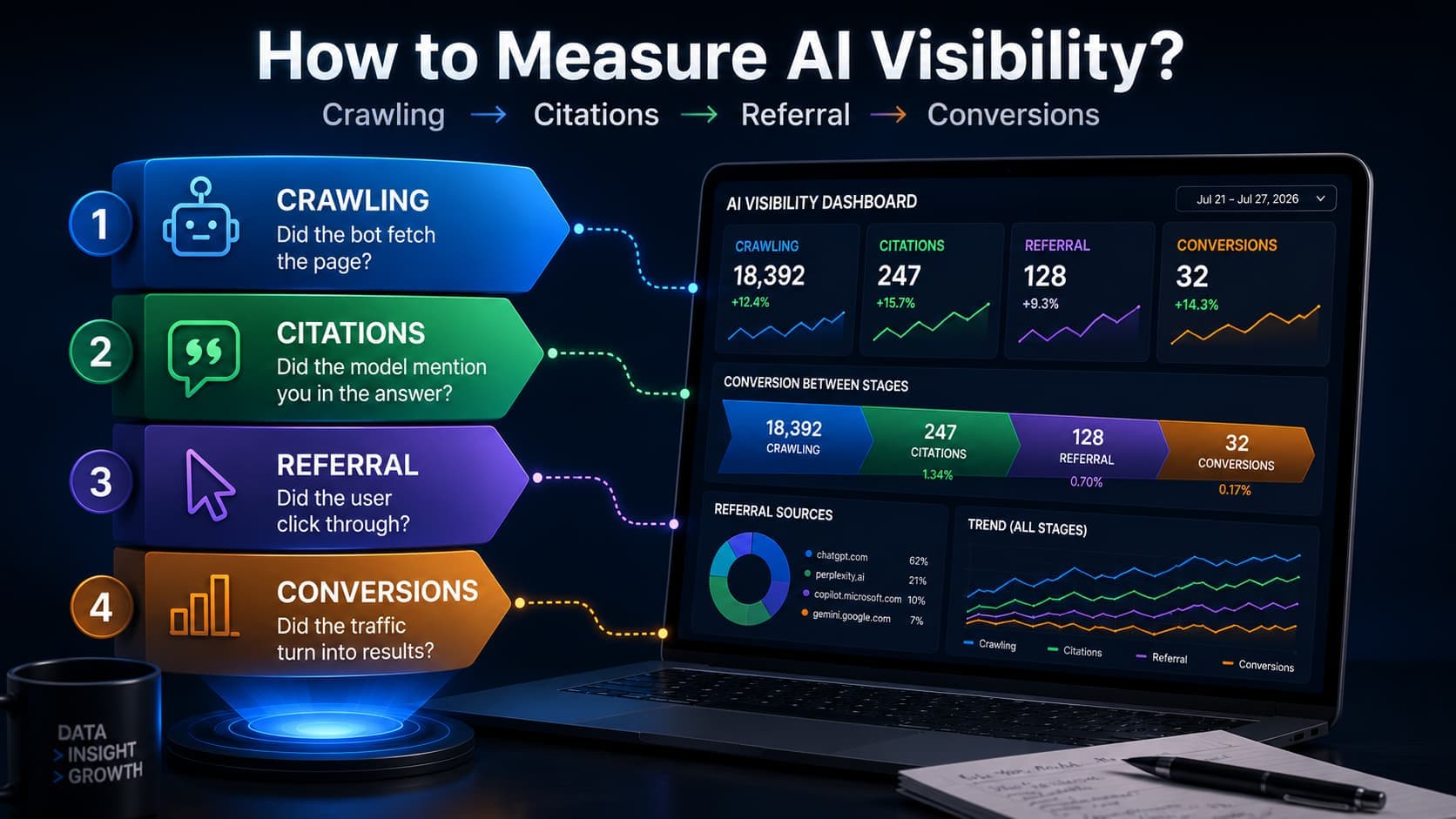
A report that only looks at organic sessions is misleading in the zero-click era. Metrics to add to the dashboard:
| Old focus | What to add |
|---|---|
| Organic sessions | Citation rate in AI answers |
| Keyword rankings | Share of voice against competitors |
| Click-through rate | Change in branded search volume |
| Page views | Conversion rate of AI-referred traffic |
We walked through how to set up these metrics step by step in our measuring AI visibility article.
Conclusion
The rise of zero-click search is not the end of SEO, but it is the end of the assumption that "high rankings bring traffic". Visibility now starts inside the answer, before the click. Brands that notice this early take their place in AI answers while competitors are still trying to interpret a falling traffic chart.
For work that treats search and AI visibility together, see our GEO and SEO service pages.