When you choose an AI integration company, judge it by how the system will be measured, secured and maintained in production, not by how impressive the demo looks. A good partner first pins down your use case, turns accuracy into a number on a test set, shows exactly where your data goes, and designs an architecture that is not tied to one model. A team that cannot give concrete answers on those four points will most likely leave your project stuck in pilot.
This guide is for executives, product owners and technical leads evaluating vendors for enterprise AI solutions. It covers which kind of project you actually need, what a competent integration partner should be able to show, which questions to ask in the first meeting, and why so many demos never reach production.
What type of AI project do you actually need?
"Let's add AI to the company" is not a project definition. Before you talk to vendors, decide which category your need falls into, because each one requires different expertise, carries a different risk profile and is judged by a different success metric.
- Question answering over company documents (RAG): Systems that answer from contracts, procedures, technical documentation or a knowledge base and cite their sources. Success depends on whether the right passage is retrieved and whether every answer shows the document it relies on.
- Document and process automation: Extracting structured data field by field from PDFs, scanned forms or email attachments, classifying and summarising documents. The critical part is that low-confidence records go to a person for approval.
- Agents that act in your systems: Agents that query databases, call APIs, create or update records. This is the highest-risk category, because the model is no longer just producing text, it is doing work.
- Customer support: Assistants that answer common questions, route tickets and hand over to a human when needed. Brand voice, the risk of wrong information and hand-off rules decide success.
- Internal copilots: Helpers that draft text, summarise records and let staff search in natural language. They must only see what each user is allowed to see.
Some problems do not need a language model at all. For demand forecasting, anomaly detection or numeric scoring, classical machine learning is often cheaper and more accurate. A vendor who tells you that openly is more trustworthy than one who proposes a large language model (LLM) for everything.
What should a competent AI integration partner be able to show?
How they measure accuracy
This is the most important criterion. A competent team builds a test set (a golden set) from your real questions and the answers you accept as correct, and reruns it automatically on every change. When a prompt changes, a model version is updated or a retrieval setting is adjusted, you can see whether the score dropped. Ask: On which set, and with which method, is accuracy measured? How are hallucinations, where the model invents facts with no source, detected? What does the system do when it is unsure? At which point in critical flows does a person approve the output (human-in-the-loop)?
"It usually gives the right answer" is an observation. "We measured this score on this set, and it fails on these questions" is data you can make a decision on.
Where your data goes (data security, GDPR and KVKK)
The vendor should be able to draw how a user query travels: which services it touches, in which country it is processed and how long it is kept. For flows involving personal data, cross-border transfer, legal basis and data processing agreements must be settled up front under the rules that apply to you, such as GDPR in the EU or KVKK in Turkey. A good partner lays out the options side by side:
- Which model provider will be used, and whether that provider uses your data for training
- Enterprise API agreements, regional hosting, or running open-weight models on your own servers (on-prem)
- Masking personal data in logs and stored prompts
- Retention periods and a deletion procedure
A team that answers this with "don't worry, it's secure" has probably never drawn the data flow itself.
How they limit what agents can access
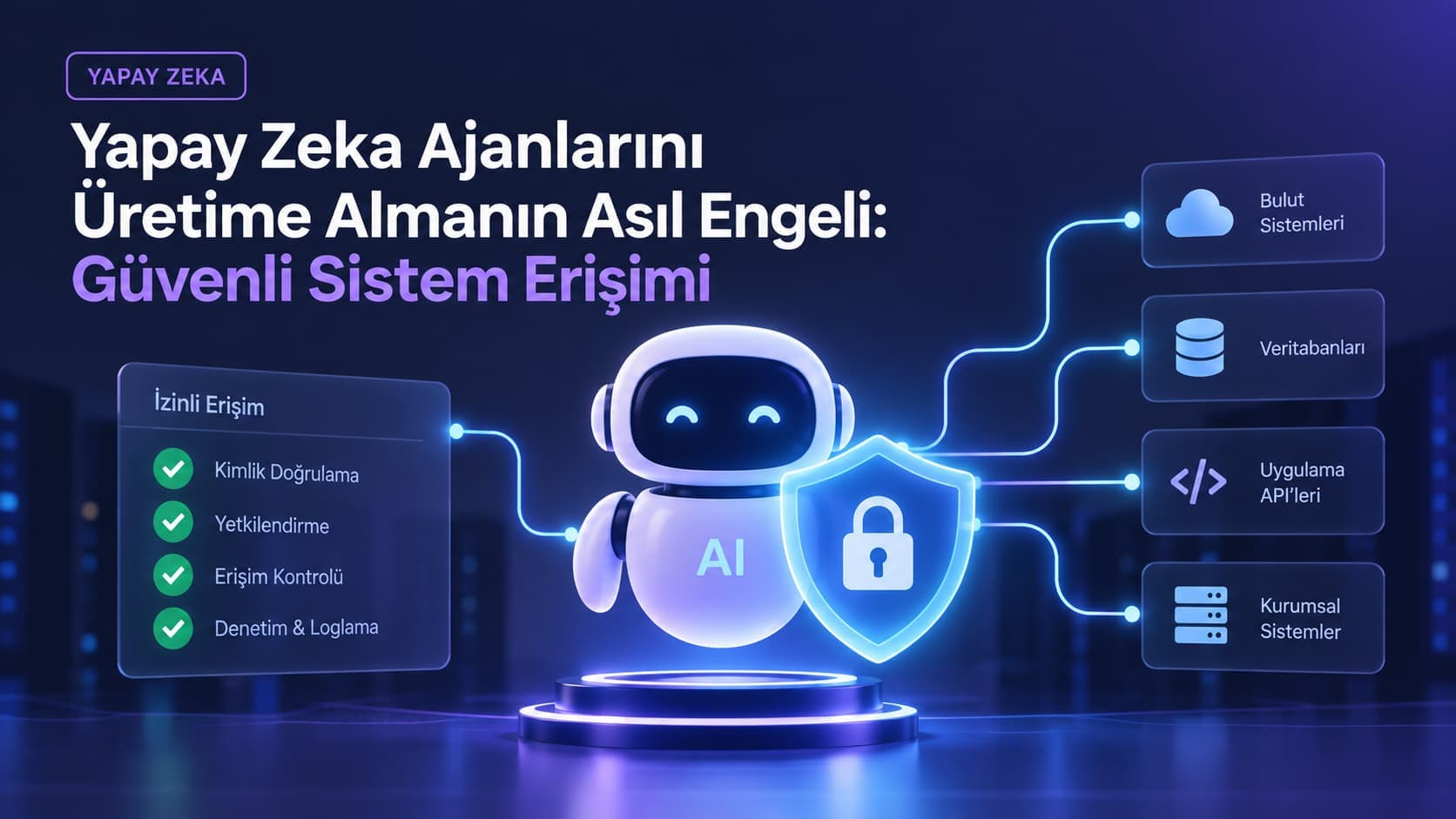
With agents, the real question is not how smart the model is but what it can reach. A competent partner applies least privilege: the agent only gets the tools its job requires, with read-only access or write access limited to specific records. Irreversible actions such as deletions, payments or bulk updates require human approval. Every run leaves a step-by-step audit log: which tool was called with which input, what came back, at which step the decision was made. We cover this in detail in our post on putting AI agents into production with secure system access.
How they integrate with your existing systems
An AI layer that does not talk to your ERP, CRM, document management system or own application stays a toy. Ask the vendor how they will work with your existing APIs, handle authentication and keep data fresh. The Model Context Protocol (MCP) is becoming a common standard for connecting models to internal systems; we looked at what it changes in what MCP is and what it means for enterprise integration.
How they keep inference costs under control
What an AI feature costs to run matters more than what it costs to build, because every request spends money. The main drivers are request volume, the length of the context sent to the model, the model tier chosen, caching of repeated content, and routing simple tasks to smaller models. A competent partner sets a budget per request, tracks spending and can predict how the bill will behave as usage grows. A team that can only say "it depends on usage" is not tracking cost.
How they monitor the system in production
An AI system is not something you ship and forget. Latency, cost per request, error and refusal rates, user feedback and the share of low-confidence answers need continuous monitoring. When the model provider releases a new version, the test set should run again and a score drop should raise an alert. If you cannot see the monitoring dashboard and alert rules during the pilot, you will not see them in production either.
How they avoid locking you into one vendor
The model market moves fast. The model that fits today may be expensive, slow or outclassed tomorrow. In a model-agnostic design, model calls sit behind a single layer, so switching providers does not mean rewriting the application. What makes that switch safe is, again, the test set: you measure the new model on the same set, compare, and decide.
Who owns the prompts, code and evals
The contract should state clearly that source code, prompts, evaluation sets, data pipelines and infrastructure definitions belong to you. A vendor that keeps prompts locked inside its own platform, or will not hand over the test set because it is an "internal tool", makes it impossible to move the system to another team. At handover, also make sure your team actually understands the code; the knowledge debt that builds up in AI-assisted development is a hidden cost that makes maintenance harder later.
Which questions should you ask in a vendor meeting?
Use the table below as a checklist in first conversations with AI integration companies.
| Question to ask | Good answer | Red flag |
|---|---|---|
| How do you measure accuracy? | We build a test set from your real questions, run it automatically on every change and share the results as a report. | "We tried it, it works well." No method, no set. |
| What happens when the model does not know the answer? | It says so when it finds no source, and low-confidence answers are routed to a person. | "The model is smart enough, it won't make things up." |
| Which services and which country does our data go to? | A data flow diagram, provider options, retention periods and a GDPR or KVKK assessment. | Vague reassurance, no diagram. |
| With what permissions will the agent run? | Least privilege, approval for irreversible actions, an audit log for every step. | Giving the agent an admin account or full database access. |
| What if we want to switch model providers? | Model calls are abstracted; the new model is measured on the same test set before switching. | An architecture deeply tied to one provider's proprietary tooling. |
| How do you control running costs? | Per-request budget, caching, model routing, a cost monitoring dashboard. | Being told cost simply "depends on usage". |
| What do you monitor in production? | Latency, cost, error rate, user feedback, alerts on score drops. | Monitoring postponed to "later". |
| Who will own the prompts, code and test sets? | All of it is yours, written into the contract, with repository access from day one. | Prompts locked inside the vendor's platform. |
What is the difference between a demo and production?
An AI demo is easy, because it only has to work once, for one scenario. A production system has to run every day, on thousands of different inputs, with a known cost and counted errors. The reasons so many AI projects stay stuck in pilot are usually structural rather than technical:
- No definition of success: Nobody agreed on what counts as "accurate enough", so nobody can decide whether the pilot is finished.
- No measurement: Without a test set every improvement is a guess and every model update is a risk.
- Real data and permissions not solved: The demo ran on sample files; production has to deal with access rights, personal data and scattered sources.
- Not embedded in a business process: Nobody designed which screen the output lands on, or whose approval it needs.
- Cost surprises: Running cost at real volume was never estimated, so scaling looks risky.
- No fallback: Nobody knows whether the process still works if the AI layer is switched off.
Ask the vendor: "What is left to take this demo to production?" If the answer walks through the points above one by one, you are talking to the right kind of team.
How do we approach AI projects at Detartech?
At Detartech we do not train models from scratch. We place existing language models inside the product you already run and the process your team already follows, on two conditions: the result has to be measurable, and it has to be reversible. Measurable means accuracy is tracked as a number on a test set. Reversible means that if the AI layer is switched off, the process keeps working the way it did before.
We run projects in three stages: proof of concept, pilot and production. We work in two-week sprints, closing each one with a running version and its measurement. Code is peer reviewed, deployments go through automated CI/CD, and 30 days of post-launch support are included. An example from our work is Lextum AI, an AI-powered legal document management platform. You can read more about RAG, document automation and agent workflows on our AI solutions page.
If you have a use case in mind, fill in our quick quote form. In a free initial consultation we will work out together which category it falls into, what should be measured and how your data will be protected. We reply within 24 hours.
Frequently Asked Questions
How do you choose a software company for AI integration?
Start by defining your use case, then ask the vendor to show which test set they use to measure accuracy, where your data goes, how they limit agent permissions and how easy it is to switch models. Get it in the contract that prompts, code and test sets belong to you. A team that answers these concretely is focused on building a production system, not a demo.
What should we check about data protection in an enterprise AI project?
Be clear on which model provider and which country personal data goes to, and how long it is stored. Cross-border transfer, data processing agreements and masking in logs should be assessed up front under the regulation that applies to you, such as GDPR or KVKK. For sensitive data, running open-weight models on your own servers is also an option.
Why do so many AI projects get stuck in pilot?
Usually because success criteria and a measurement method were never defined, access to real data and permissions was not solved, and the output was never embedded in a business process. A demo works for one scenario; production has to work every day on varied input at a known cost.
What is RAG and when do you need it?
RAG (retrieval-augmented generation) is a method where the model first finds relevant passages in your documents and then answers based on them. You need it when answers must rely on internal knowledge and show their sources. Because its success depends heavily on retrieving the right passage, retrieval quality should be measured separately.
Do we need to train our own AI model?
In most enterprise projects, no. Existing language models meet the need when combined with the right data access, verification and workflow. Training a model from scratch is an expensive path that only makes sense for a very specialised domain with enough labelled data.